
REVIEW · MEDELLÍN TOURS
Post-conflict Shared Tour (Paul) and Violence Medellin
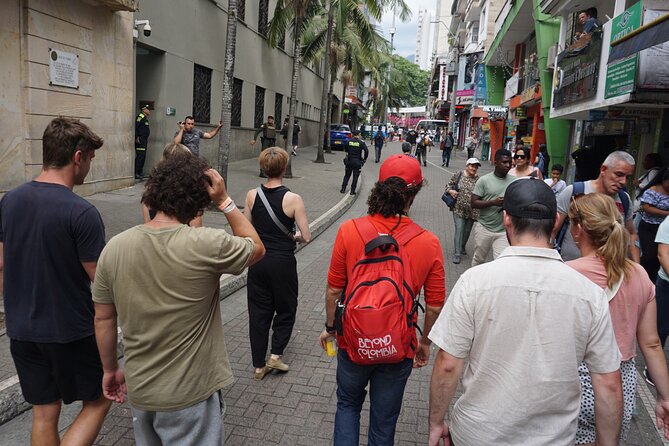
Medellín’s peace story is written in public. This is a 3-hour shared walking tour that frames the city’s post-conflict shift through education and the human-rights legacy, not just facts and dates. I love how the route connects ordinary streets to bigger themes, but there are also a couple of stops where the sights are simple, so the real payoff is in the narration.
The small-group format also helps. With a max group size of 10, your guide can actually answer questions, and that matters a lot when the topic is Colombia’s violence and recovery. In particular, guides such as Miguel and Daniel are praised for explaining social dynamics and history in clear, honest ways.
One more thing to consider: this tour is more discussion-heavy than postcard-heavy. If you mainly want dramatic viewpoints, you might feel a bit underwhelmed at places that are more about context than scenery. Still, the structure does a good job turning quick city stops into a coherent, thoughtful story.
In This Review
- Key things you’ll notice on this Medellín post-conflict walk
- Medellín’s post-conflict story starts at Parque San Antonio
- Plazuela San Ignacio and the peace-building role of education
- Comfama San Ignacio: art, culture, and social fabric
- Torres de Bomboná, modern architecture, and urban transformation
- Pasaje Cervantes murals: when street art carries messages
- Parque de Boston: a needed pause to process what you learned
- Simona Duque Park: human rights made personal
- Bicentenario Park and the walk’s finish at the Memory House Museum
- Price and value: what $14 gets you in Medellín
- Pace, group size, and what to bring to the walk
- Who should book this violence and post-conflict Medellín tour
- Should you book Paul’s shared Violence and Post-Conflict Medellín tour?
- FAQ
- What is the duration of the Medellín Violence & Post-Conflict tour?
- How much does the tour cost?
- What is included in the price?
- Are entrance tickets included for all stops?
- Where does the tour start and end?
- What time does the tour begin?
- How big is the group?
- Do I need to bring snacks or lunch?
- What is the cancellation policy?
- Is this tour physically demanding?
Key things you’ll notice on this Medellín post-conflict walk
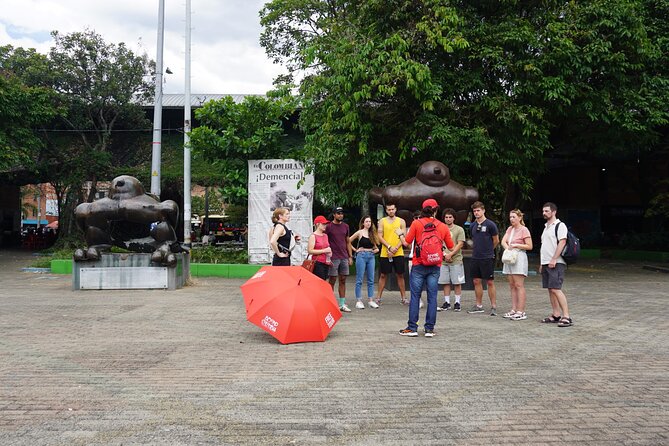
- Small group: capped at 10 people, so the guide can keep it interactive
- Education focus: you spend multiple stops on schools, culture, and peacebuilding
- Real names in the story: the route highlights people like Simona Duque
- Urban art and architecture: murals and modern towers show change you can see
- Story-led pacing: many stops are short, so listen closely as you walk
Medellín’s post-conflict story starts at Parque San Antonio
You kick things off at Parque San Antonio, a central, emblematic spot in Medellín. Here, the guide sets the tone by connecting the park to the city’s changing life over the years. It’s the kind of place where the walls and layout are familiar, but the meaning shifts as the city shifts.
I like how the tour treats a park as a living timeline. You get a sense of how public spaces can mirror what a city hopes for, and what it had to endure. This first stop is also a good warm-up, because it primes you for the rest of the walk, which is built on cause and effect.
Time-wise, plan on about 22 minutes here. If you’re the type who hates standing around, you’ll still be moving. The guide uses the park as a reference point, then quickly carries that idea onward.
More things to do in Medellin:
- Medellin: Comuna 13 Graffiti Tour, Cable Car & Street Food
★ 4.8 · 9,046 reviews - Comuna 13 Graffiti Tour with Street Food
★ 5.0 · 7,503 reviews - Museo Pablo Escobar
★ 5.0 · 7,242 reviews
Plazuela San Ignacio and the peace-building role of education
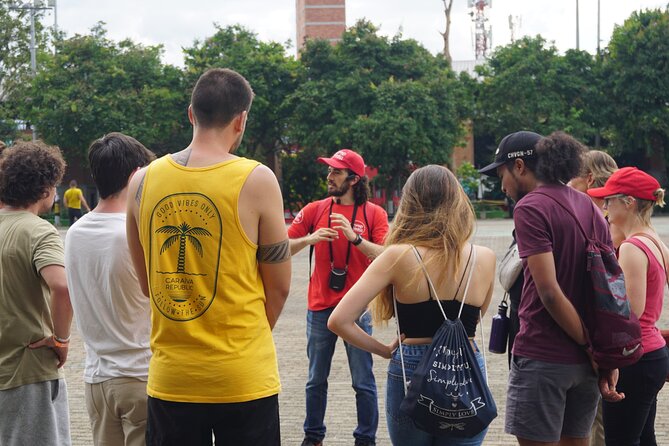
Next comes Plazuela San Ignacio, and this is where the tour makes its main argument. Education is treated as one of the practical tools that helped Medellín move toward peace, not just as a feel-good slogan.
You’ll hear how learning, schools, and community programs fit into the broader transformation. The square becomes more than a pretty location, because the guide ties it to what education can change when violence has disrupted normal life.
It’s a short stop, around 22 minutes. That brevity is good, because it keeps momentum. The only drawback is that if you love long museum-style explanations, you might wish the tour spent more time on this theme. But the upside is that the tour covers multiple angles across several stops.
Comfama San Ignacio: art, culture, and social fabric
Then you head to Comfama San Ignacio, a cultural center focused on art, culture, and education. This is one of the places where you can see how the city tried to rebuild community life through programs and public-facing activities.
The guide explains what kinds of efforts were created to strengthen the social fabric and support peaceful coexistence. It’s the kind of stop that works even if you skip museum hours back home. You’re not there to admire one artifact. You’re there to understand why the center exists and what role it played in the recovery.
Another plus: the stop is about 22 minutes. So you get a focused snapshot without dragging the walk out.
Torres de Bomboná, modern architecture, and urban transformation
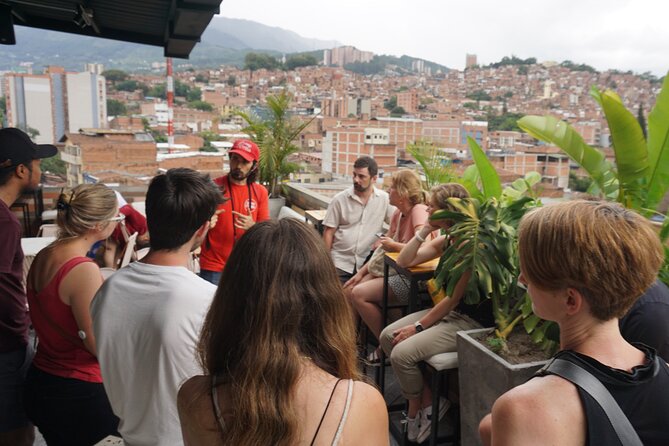
At Torres de Bomboná, the tour shifts from institutions to skyline signals. These towers are discussed as a modern architectural landmark, and the guide connects their presence to how Medellín has been reinventing itself.
I like this stop because it turns “architecture talk” into something more useful. Instead of just pointing at buildings, the guide frames them as part of a larger urban transformation story, tied to identity, planning, and what a city chooses to emphasize.
This is still a short stop, about 22 minutes. If you’re a design nut, you might want more time. If you’re not, don’t worry. The tour’s real value is the interpretation, not a long architectural lecture.
Same city, a completely different day:
- Guatapé Tour: Piedra del Peñol with Boat Tour, Breakfast, Lunch
★ 5.0 · 7,035 reviews - Medellín: The Real Pablo Escobar Tour
★ 4.8 · 3,205 reviews - Day Trip To Guatapé with ,Breakfast, Lunch and Boat Ride
★ 5.0 · 2,996 reviews - Comuna 13 Graffitour knows the urban art district of Medellín
★ 5.0 · 2,856 reviews
Pasaje Cervantes murals: when street art carries messages
Pasaje Cervantes is where the tour leans into visual storytelling. You look at colorful murals and hear about the artists and the messages behind the work. The idea is simple: public art can change how people feel about their own neighborhoods.
This stop is especially good if you like to travel with your eyes open. You start noticing how walls can act like community bulletin boards, reflecting hopes, tensions, and calls for change.
As always, you’re there for about 22 minutes. If you want extra time to photograph, you’ll likely have to do it quickly before the group moves on. But the guide gives you enough context that your photos feel like more than decoration.
Parque de Boston: a needed pause to process what you learned
After a run of information, the tour adds a short break at Parque de Boston. The guide invites you to reflect on what you’ve seen and learned so far.
This is more than a rest stop. It gives you a chance to stitch together the earlier themes: public spaces, education, cultural programs, architecture, and art. When the second half of the tour turns toward specific human-rights stories, that mental pause helps.
Time is again about 22 minutes. It’s a gentle reset, and it keeps the pace from turning into pure information overload.
Simona Duque Park: human rights made personal
Now we move into the human-rights thread of the story. Simona Duque Park is a tribute to Simona Duque, and the guide shares her story and legacy.
This is one of those stops where the tour stops being abstract. You’re not just learning about systems. You’re learning about a person whose life became a symbol for rights and dignity.
One practical note: admission is listed as not included here. So you might pay an entry ticket depending on what’s required at the time of your visit. I’d plan a little extra budget just in case.
This stop also runs about 22 minutes, which helps you connect emotionally without dragging out the group schedule.
Bicentenario Park and the walk’s finish at the Memory House Museum
The final stop is Bicentenario Park, a modern and sustainable space positioned as part of Medellín’s future. The guide brings the themes together again, with a focus on challenges and opportunities on the road to peace.
You end at the Memory House Museum (at Parque Bicentenario). The pairing makes sense. You’re not just leaving with ideas. You’re ending at a place that grounds those ideas in memory and context.
Admission is also listed as not included for this final part, so plan for possible entry costs. The good news is that the stop is still short, around 22 minutes, and the tour ends right after, so you won’t feel like you’re stuck paying extra for a long add-on.
Price and value: what $14 gets you in Medellín
The price is listed at $14 per person for a shared tour, and it functions like a tip-based walking tour where the value you pay supports the guide’s work (minus a platform commission). In plain terms, you’re paying for guided storytelling and organization, not a packaged bus ride.
For this topic, that matters. You’re dealing with violence, conflict history, and a complex peace process. A good guide helps you understand what you’re looking at, why it matters, and how everything connects without turning it into a textbook.
The reviews also point to a key value driver: guides who speak clearly and handle questions. People highlighted guides like Miguel, Daniel, and Paul for explaining the city’s social dynamics and the historic development of Colombia. When that happens, the short stops start to feel like purposeful chapters.
About the places themselves, there’s a balance. One reviewer pointed out that some locations may not be visually exciting on their own, but the story behind them made the time worth it. I agree with that tradeoff. If you want scenic hotspots, this tour might feel too “thoughtful” for your taste. If you want to understand Medellín, it’s a strong fit.
Pace, group size, and what to bring to the walk
This is a 3-hour tour, and each of the eight stops is roughly 22 minutes, plus walking time between points. The rhythm is steady, so you’re not stuck for long at any one location. That’s ideal in a city where plans can change fast.
Group size is capped at 10. That’s a big deal on a shared tour about difficult subjects, because you want a guide who can respond to questions without shutting things down.
Comfort matters here too. The tour notes you should have a strong physical fitness level. That doesn’t mean it’s a mountain hike, but it does mean you should be ready for a walking-heavy 3-hour program.
Snacks, lunch, and tips are not included. So bring water if you think you’ll need it. For tips, the format already suggests that the amount you pay ahead is tied to tipping the guide’s work, but it never hurts to have some flexibility if you feel the guide truly earned it.
Who should book this violence and post-conflict Medellín tour
Book it if you want context, not just sightseeing. This tour is built for people who like to understand a place by how it rebuilt itself, where it invested in education, and how culture and memorialization shaped public life.
It also suits you if you’re curious about how different tools show up in city space: squares, cultural centers, murals, and modern architecture. In other words, it’s a good “how Medellín changed” walk.
Skip it if you only want view-based stops and photo spots. This isn’t that kind of tour. The narration is the main attraction.
It’s also a solid choice for travelers who prefer a smaller group. With a max of 10 people and a certified guide, you’re less likely to feel like a number in a big crowd.
Should you book Paul’s shared Violence and Post-Conflict Medellín tour?
I’d say yes if your priority is learning why Medellín looks the way it does today. This tour is structured around the city’s transformation themes, from education and cultural programs to human-rights legacy and the Memory House Museum finish.
I’d say no if you want a light, purely scenic walk. Some stops can feel visually modest. The payoff is mostly in what the guide explains in plain language.
One smart move: go in ready to listen. If you lean into the stories, you’ll leave with a clearer sense of Medellín’s post-conflict path and what peacebuilding actually looks like on the ground.
FAQ
What is the duration of the Medellín Violence & Post-Conflict tour?
The tour lasts about 3 hours.
How much does the tour cost?
The price is $14.00 per person.
What is included in the price?
A certified guide is included.
Are entrance tickets included for all stops?
Admission tickets are free for the first six stops. Admission tickets are not included for Simona Duque Park and Bicentenario Park.
Where does the tour start and end?
It starts at Parque San Antonio (Cl 44 #50, La Candelaria) and ends at the Memory House Museum (Parque Bicentenario, Cl. 51 #36-66, La Candelaria).
What time does the tour begin?
The start time is 2:00 pm.
How big is the group?
The tour has a maximum of 10 travelers.
Do I need to bring snacks or lunch?
Snacks and lunch are not included.
What is the cancellation policy?
You can cancel for a full refund if you cancel at least 24 hours before the experience’s start time. The policy notes free cancellation within that window.
Is this tour physically demanding?
The tour requires travelers to have a strong physical fitness level.
If you want, tell me your travel dates and what kind of walking pace you prefer. I can help you decide if this 2:00 pm start works with the rest of your Medellín plan.
Hot off the list in Medellin
- Tour Medellín: Pablo Escobar and Commune 13★ 5.0 · 3 reviews
- Tour Guatapé – Piedra del Peñol with departure from Medellín★ 5.0 · 24 reviews
- Tour Guatapé con visita a Granja de las Llamas y las Alpacas★ 3.5 · 11 reviews
- Shared Tour to Comuna 13 & Aurora Cable Car in Medellin★ 5.0 · 4 reviews
- Medellín: Flower Farm & Silletero History Tour★ 4.3 · 23 reviews
- Shared Tour Medellin’s Violence & Post-conflict after Pablo★ 4.1 · 3 reviews
- From Medellín: El Retiro Private Tour with Food Tastings★ 4.4 · 8 reviews
- Comuna 13 Neighborhood & Street Art Private Tour★ 4.7 · 12 reviews
Medellín Tours, compared.
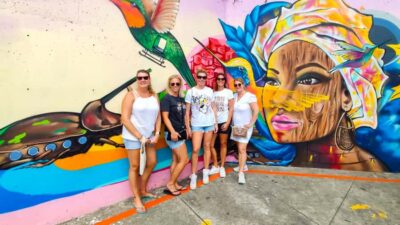
Comuna 13 Graffiti Tour, Cable Car & Street Food
Read our review →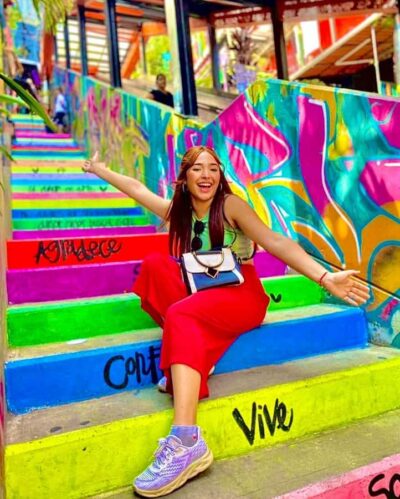
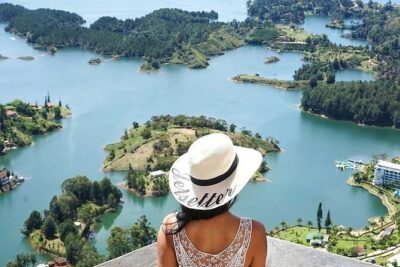
Guatapé Tour: Piedra del Peñol with Boat Tour, Breakfast, Lunch
Read our review →
Day Trip To Guatapé with ,Breakfast, Lunch and Boat Ride
Read our review →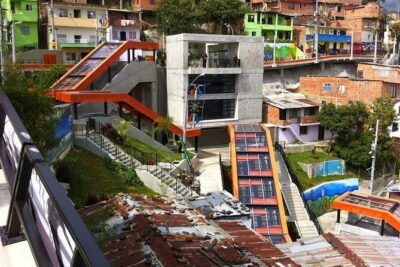
Comuna 13 Graffitour knows the urban art district of Medellín
Read our review →