
REVIEW · CYCLING TOURS
Bogotá Bike Tour with street art
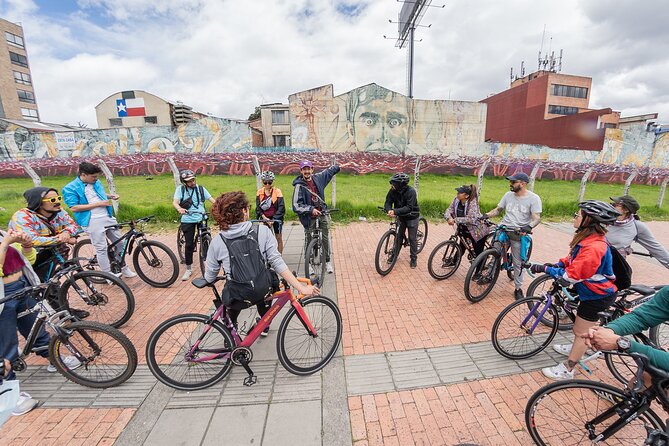
Street art in Bogotá looks different from a bike. This Bogotá street art bike tour puts you on two wheels for stories behind walls, from old colonial streets to huge mural blocks.
I especially like the small group size. You get time with the guide, and I’ve seen guides named Miguel, Alejandro, Fernandao, Edgar, and Nick praised for going beyond surface details. I also love that the ride balances art with neighborhood texture, including a stop connected to coffee roasting.
One consideration: Bogotá weather and traffic can stretch the day, and I did spot a serious safety account from one participant. Use the buddy system, keep your phone secure, and stay alert in any area your guide asks you to pause.
In This Review
- Key highlights worth your attention
- Why a bike works so well for Bogotá murals
- Meeting at Cerros Bike Tours, then riding with real guidance
- Stop 1: La Candelaria streets and Chorro de Quevedo history break
- Centro Mayor murals and a coffee factory pause that breaks the ride
- Stop 3: Santa Fe murals and the stories behind social struggle
- Stop 4: Teusaquillo architecture ride, English Victorian to art deco
- Stop 5: La Macarena, architecture and neighborhood change
- How much time and value you’re really getting for $44
- Comfort and safety: what to do in rain, traffic, and pause points
- Should you book this Bogotá street art bike tour?
- FAQ
- How long is the Bogotá street art bike tour?
- What’s included in the price?
- Are the mural stops free to enter?
- How big is the group?
- What should I wear or bring?
- What is not included?
Key highlights worth your attention
- Small group max 15 means more back-and-forth and fewer lost moments.
- La Candelaria plus Chorro de Quevedo ties murals to Colombia’s deeper story.
- Centro Mayor murals and a coffee stop add a local break, not just wall photos.
- Santa Fe and La Macarena street art themes connect creativity to social realities.
- Teusaquillo architecture mix shows how foreign styles shaped Bogotá in the 1930s.
Why a bike works so well for Bogotá murals
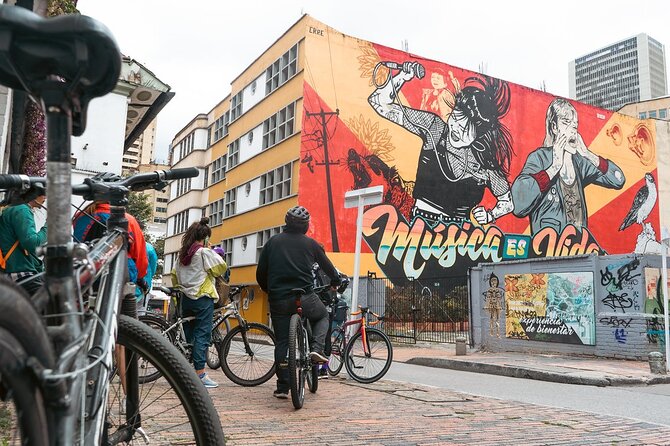
Bogotá is a city where art is not only on museum walls. It’s on building sides, under bridges, along long streets where local life keeps moving. A bike tour is a smart way to see this because you travel between neighborhoods fast, without feeling like you’re running on foot.
The biggest win is pacing. You get enough time at each stop to look closely, then you roll to the next area before the light, temperature, or your energy levels drop. You also learn faster when the setting changes every few minutes. A mural in one neighborhood hits differently once you’ve just ridden past colonial streets, a formal 1930s block, or a modern shopping area.
If you like street art photography, this tour helps your timing. You’ll be stopping at key photo-and-story points like Chorro de Quevedo and the major mural areas around Centro Mayor, then moving on before you lose the thread.
More Bike Tours in Bogota
- Bogotá Bike Tour
★ 5.0 · 3,329 reviews - Bike Tour in La Candelaria Bogotá
★ 4.5 · 172 reviews - Bike Tour in Bogota Historical Sites and Fruit Market
★ 5.0 · 171 reviews
Meeting at Cerros Bike Tours, then riding with real guidance
You’ll meet at Cerros Bike Tours, Cra. 4 #12-78, and the tour ends back near the same spot. It’s also close to public transportation, which matters if you want to plug this into the rest of your Bogotá days.
What I find practical here is that the basics are handled for you:
- A bike and helmet are included.
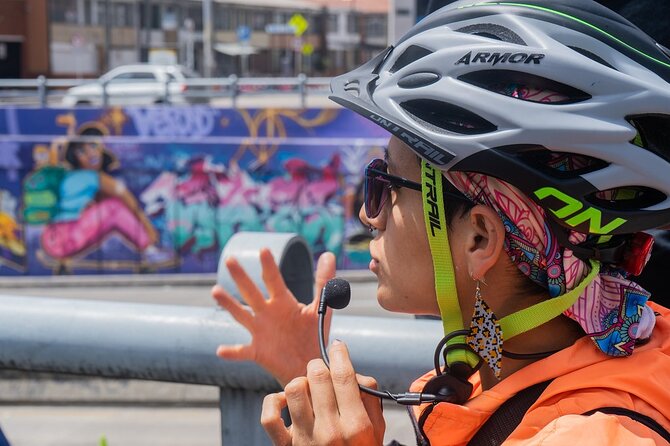
- You travel with a professional English- and Spanish-speaking guide.
- If you choose it, there’s hotel pickup and drop-off.
I’d pack for movement in Bogotá. Comfortable clothes and shoes are a must since you’ll be on and off the bike. Bring a rain jacket in case conditions turn gray, and pack sunscreen and sunglasses for the sunny stretches that can pop up even when the air feels chilly. A lot of people report cold or rainy conditions, and the tours still run, so plan to layer.
Finally, expect a guide to set the tone. In the accounts I saw, guides were friendly and willing to adjust when something changed, like weather or bike trouble. One person even described a backup plan when a tire went flat, with another guide handling the bike swap so the group could keep moving.
Stop 1: La Candelaria streets and Chorro de Quevedo history break
Your first stretch is around La Candelaria, the oldest neighborhood in the capital. This is where the contrast is immediate. You’ll see colonial-style facades, then you’ll turn into streets where street art shows up bold and personal, not packaged for tourists.
What makes this stop work is the mix of visuals and context. You’re not just looking at color. You’re building meaning. You’ll get a short stop at Chorro de Quevedo, a place that helps you connect the dots to Colombia’s past before you move on to modern mural stories.
Why this matters for your day: starting with La Candelaria keeps your brain switched on. After that, murals in other neighborhoods feel less random. They start to look like commentary, memory, and identity, shaped by where people live and what they’ve lived through.
A small practical note: this is the “warm-up” segment, about one hour. If you tend to get out of breath quickly, take it slow at the beginning. Most route segments are reported as mostly flat, but you’ll still feel the altitude and city momentum if you rush the first few minutes.
Centro Mayor murals and a coffee factory pause that breaks the ride
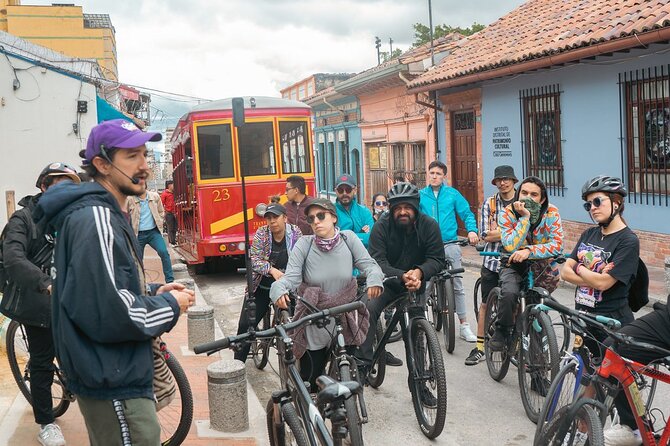
Next you head toward Centro Comercial Centro Mayor and spend time admiring large-scale mural work in that area. You’ll also pass through multiple neighborhoods along the way, including Centro, Teusaquillo, Santa Fe, and La Macarena, so your eyes keep changing from street to street.
The best part here, beyond the art, is the stop that feels like Bogotá life. You’ll visit a local coffee factory and see how coffee is roasted, then you’ll have a chance to look at the process up close. Some groups have even described sampling coffee, so you might get that extra treat, but at minimum you’ll get the visual story of how coffee moves from bean to flavor.
This break is valuable if you want a street art tour that doesn’t feel like a nonstop photo walk. It also gives you time to refuel before the later stops, when your legs might start to feel the rides between neighborhoods.
One drawback to consider: the tour does not include food and drinks, so you’re relying on this coffee stop for comfort and timing. If you get hungry fast, plan to grab something before the tour or after, not during.
A few more Bogota plans worth comparing
- Bogotá: Shared Bike Tour
★ 4.6 · 83 reviews - Bogotá Private Bike Tour with Transportation
★ 5.0 · 65 reviews - Bogotá Private Bike Tour with Transportation
★ 4.6 · 14 reviews - BIKE Tour to Bogota’s *Botanical Garden+ Market*
★ 5.0 · 12 reviews
Stop 3: Santa Fe murals and the stories behind social struggle
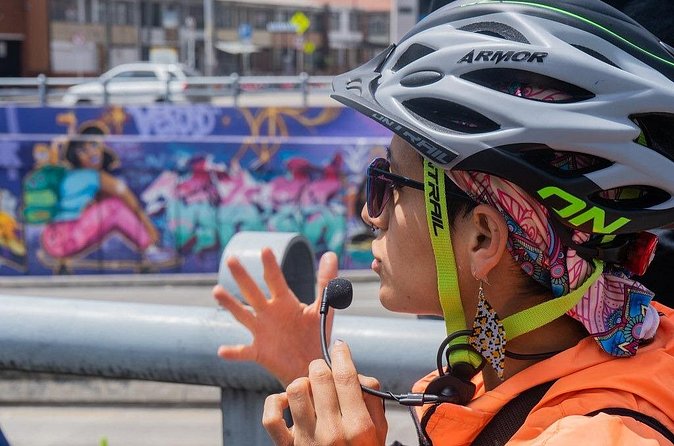
In Santa Fe, the emphasis shifts deeper into what murals can communicate. You’ll spend around 30 minutes looking at impressive works and creative expressions that reflect Colombia’s cultural diversity and history, including social pressures and struggles.
I like this stop because it helps you read street art like a language instead of a decoration. When a guide connects a mural to neighborhood context, you start noticing recurring themes: who is represented, what is ignored, and what message is pushed to the surface. Without that context, it’s easy to treat street art like background noise for your photos. With it, you’re seeing why people paint in the first place.
Practical tip: bring your “slow eyes” here. Give yourself a few extra seconds to look at faces, symbols, and text, not only the color palette. Murals often reward close attention, and 30 minutes goes fast if you take pictures nonstop.
Also keep an eye on the light. Santa Fe murals can look different depending on how the sun hits the walls, and you’ll move on to Teusaquillo after this, so make the most of your viewing window.
Stop 4: Teusaquillo architecture ride, English Victorian to art deco
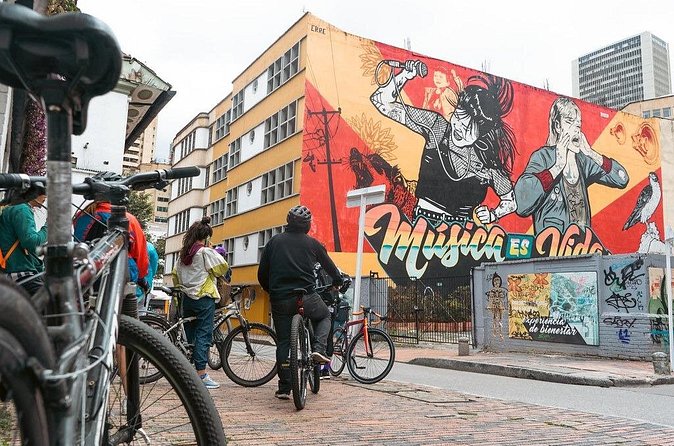
Then comes Teusaquillo, about 30 minutes, known for its mix of architectural styles. This is where the tour turns from mural stories to built history.
You’ll see an unusual blend that can include English Victorian, art deco, and modernist houses. And the guide’s job is to connect those influences to Bogotá’s development, explaining how that modern elegance appeared and what it meant for the city.
Why I think you’ll appreciate this stop: it’s a change of pace from street art, but it supports the same theme. Both murals and architecture reflect identity and power. Teusaquillo shows how global styles landed here, while street art often shows how communities respond, resist, or reframe what society expects.
A practical note: architecture spotting is easy to do wrong if you’re pedaling too fast. Slow down at each building your guide calls out, and use the moments when you stop to take notes mentally. Later, you’ll recognize those styles when you pass similar streets on your own.
Stop 5: La Macarena, architecture and neighborhood change
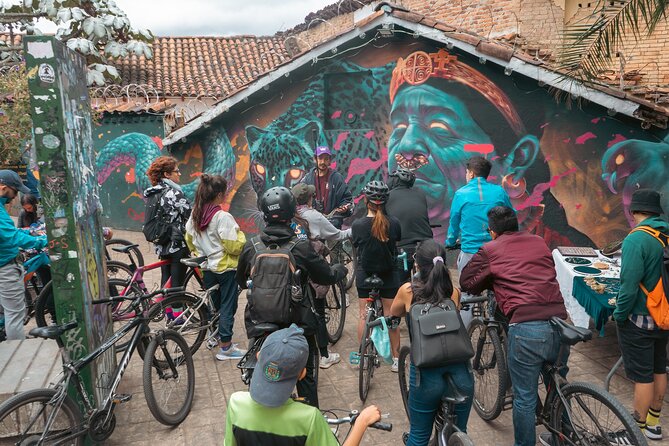
Your final stop is La Macarena, also around 30 minutes. Here you combine what you learned in the earlier sections, especially how neighborhoods evolve through a mix of architecture, urbanization, and local history.
This last segment feels like a wrap for the day. You’ve seen old colonial layers in La Candelaria, big mural statements around Centro Mayor, social-context murals in Santa Fe, and the style shifts of Teusaquillo. La Macarena ties it together by showing how streets change over time and how design, growth, and community needs leave traces you can still see.
If you like walking a route and then thinking about it later, this stop does that for you. It gives you a mental map of Bogotá that doesn’t rely on landmarks only.
How much time and value you’re really getting for $44
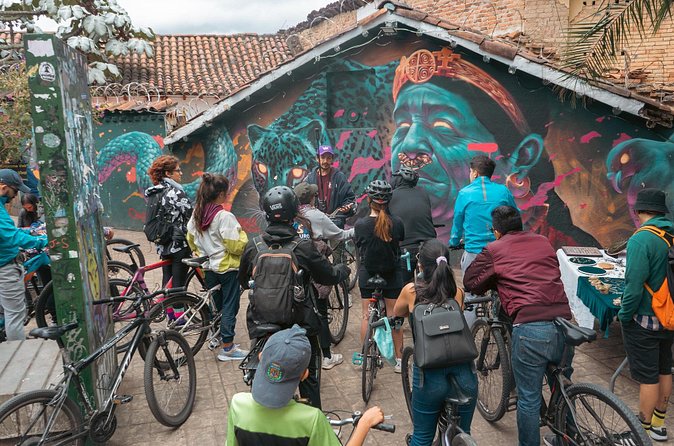
The stated duration is about 3 hours. With hotel pickup and drop-off, your total time can be longer, and Bogotá traffic can slow things down. I’d plan for a half-morning or half-afternoon block, not a quick two-stop sprint.
The value question comes down to what’s included. For $44 per person, you get a professional bilingual guide, a bike and helmet, and admission is free at the stops listed for you. The cost is paying for expertise and routing, not for ticketed attractions.
That said, I did see one common complaint: some people felt the price was higher than what they heard about walk-up or other booking options. If you’re price sensitive, it can be worth checking options in Bogotá before you commit, especially if you’re already in the city and can book directly.
On the plus side, multiple people described the route as time-efficient, with plenty of sightseeing for the money. Small group size also matters for value. You’re more likely to ask a question, get an extra explanation, and feel like the guide is present, not just moving people down a checklist.
Comfort and safety: what to do in rain, traffic, and pause points
Comfort is mostly about weather. Bogotá can feel cold, and rain happens. The guidance recommends a rain jacket, and one account described cold and rainy weather with the tour still continuing. Dress in layers and keep your hands warm if you get cold easily. If you’re cycling, even a light drizzle can change how your bike feels.
Traffic is another factor. The tour covers multiple neighborhoods, and city congestion can slow your movement. The good news is that the bike route is often described as mostly flat, which helps your comfort and stamina.
Now the safety part. One participant reported a robbery at gunpoint during a moment when the group stopped for rain in an area near Calle 26 y Caracas. That account also said the response felt disorganized and that the group left the area using a taxi while waiting for safety to improve. I’m not going to tell you this is typical, because the data you shared includes both positive experiences and this serious negative incident. I will tell you what to do with this information:
- Follow your guide’s instructions immediately, especially around pause points.
- Keep valuables out of sight and secure your phone.
- Stay close to the group at crossings and stops.
- If you feel uneasy, speak up to your guide on the spot.
Good street art tours rely on you blending in with local movement, not standing out and asking for attention.
Should you book this Bogotá street art bike tour?
I’d book this if you want a guided street art day that’s more than a mural photo spree. The combination of La Candelaria and Chorro de Quevedo, huge wall work around Centro Mayor, and the neighborhood history angle in Teusaquillo is a strong mix for first-timers and repeat visitors alike.
You should also book it if you like small groups. A max of 15 is ideal when the guide is bilingual and when the goal is to understand what you’re seeing.
I’d think twice if safety is your top priority and you’re planning to travel very late or with high-risk expectations. While most experiences sound smooth, one account in your provided information was frightening. If that risk keeps you up, you might prefer a route-focused walking tour or another bike operator with a strong safety reputation you can verify.
If you decide to go, go prepared. Layer for cold or rain, keep your phone secure, and take your time looking at the murals when you stop. That’s when the tour becomes more than movement, it becomes context.
FAQ
How long is the Bogotá street art bike tour?
It’s about 3 hours. If you choose hotel pickup and drop-off, your total time may be longer depending on timing and city traffic.
What’s included in the price?
The tour includes a professional English- and Spanish-speaking guide, a bicycle and helmet, and hotel pickup and drop-off if you select that option.
Are the mural stops free to enter?
The listed stops include free admission, including Chorro de Quevedo, Centro Mayor, Santa Fe, Teusaquillo, and La Macarena.
How big is the group?
The group size is limited to a maximum of 15 travelers.
What should I wear or bring?
Wear comfortable clothes and shoes. Bring a rain jacket, sunscreen, and sunglasses because the weather can change.
What is not included?
Food and drinks are not included, and optional tips, gratuities, and personal expenses are also not included.
More Street Art Tours in Bogota
- Graffiti Tour: a fascinating walk through a street art City
★ 5.0 · 1,074 reviews - Graffiti Tour: a fascinating walk through a street art City
★ 5.0 · 5 reviews - Bogotá Street Art and Graffiti Tour 3 Hrs
★ 5.0 · 5 reviews - Medellín: Private Comuna 13 Street Art Tour
★ 4.8 · 88 reviews
Hot off the list in Bogota
- Zipaquirá and Salt Cathedral Muisca Heritage with Guide – Private★ 4.5 · 23 reviews
- Catedral de Sal desde Bogotá en Tren★ 5.0 · 5 reviews
- Tour of Zipaquirá: Visit the Salt Cathedral and the main squares★ 4.5 · 55 reviews
- Zipaquira Salt Cathedral★ 5.0 · 4 reviews
- LOCAL GUIDE Zipaquirá PRIVATE TOUR – Salt Cathedral and Salt Oven★ 5.0 · 24 reviews
- Zipaquirá Salt Cathedral: An architectural wonder.★ 4.5 · 24 reviews
- Private Zipaquira Salt Cathedral and Guatavita Lagoon Tour from Bogota★ 4.5 · 44 reviews
- Zipaquira Salt Cathedral★ 4.5 · 12 reviews
Cycling Tours, compared.
Half Day Bike Tour in Medellin – Local snack, Coffee or Beer
Read our review →
Electric Bike City Tour Medellin With Colombian Coffee and Snack
Read our review →
Medellín Essential: history & local life on E-bike
Read our review →
Local neighborhoods and included food on e-bike
Read our review →
Night Bike Tour In Medellin, Typical Snacks, Beer and Spectacular Viewpoints
Read our review →
Browse the lists this tour appears in