
REVIEW · COMUNA 13 TOURS
Walls of Wonder: Immersive Journey through Distrito Graffiti
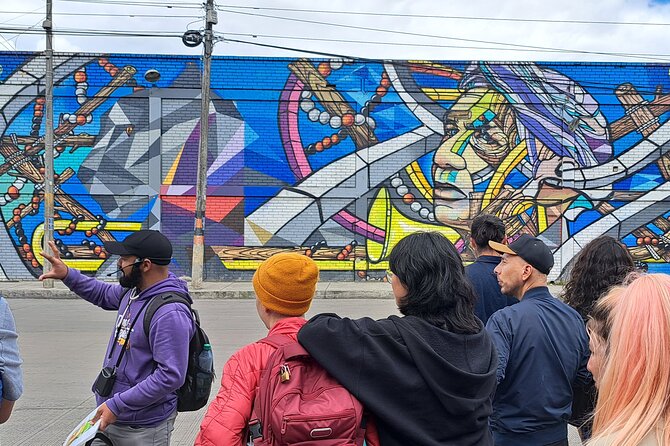
Bogotá street art hits harder up close. Walls of Wonder takes you through Distrito Graffiti on giant walls, where international artists and local stories share space right in the neighborhood.
I especially love how each stop pairs what you see with what it means, from coca symbolism to worker portraits. I also love that the tour is led in English by guides such as Jay, Jeff, Jahir, Camilo, and Tet.artist, with plenty of room for questions. The main drawback is that it is a mostly walking route, so it may be challenging if you have limited mobility.
In This Review
- Key Highlights You’ll Actually Feel
- Distrito Graffiti’s Mission: Art as a Loud, Public Conversation
- Meeting in Puente Aranda and Finishing Where You Started
- Stop 1: Distrito Grafiti, Where the Project Explains Itself
- Stop 2: Soplascol sas and the Hoodie Artist With Real Tools
- Stop 3: Eds Terpel San Andres and the Skull That Explains Coca
- Stop 4: TEXTILES FACTORY TEXTRAMA and Wild-Style as Abstract Writing
- Stop 5: Kr 54 – Cl 5C and Jaune’s Mini Stencils of Workers
- Stop 6: Metalfischer, the Water Uterus, and Colombia’s Frailejón
- Stop 7: Centro Creativo Textura, Tucans, Indigenous Life, and a Jaguar Arm
- Stop 8: LA AREPERIA DC and the Black-and-White Mental House on Fire
- Stop 9: Industrias Proton Ltda and Salsa’s Spiritual Blend
- Stop 10: TelefonoPostobón Planta San Rafael Industrial, Guache’s Afro Portrait Plus Ecology and Nostalgia
- Stop 11: COMTUCAR S.A.S and Sabotaje al Montaje’s Four-Story Old Man
- Stop 12: FIORENZI CEDI, Train Graffiti Coexisting With Muralism, Plus a Psychedelic Totem
- Stop 13: Todo Cajas Jemd S.a.s, Sci-Fi Wonder and a School-Book Clock
- Stop 14: Inversiones Merlup Sas and the Tour’s Human Closing Moment
- Guides Are the Secret Sauce: Jay, Jeff, Camilo, Jahir, and Tet.artist
- Price and Value: $25 for a Lot of Wall Time
- Who Should Book Walls of Wonder, and Who Might Skip It
- Should You Book Walls of Wonder?
- FAQ
- How much does the Walls of Wonder tour cost?
- How long is the tour?
- Where does the tour start and end?
- How many people are in a group?
- Is this tour guided?
- Is food included?
- Are admission tickets required for the stops?
- Is the tour suitable for limited mobility?
- Are service animals allowed?
Key Highlights You’ll Actually Feel
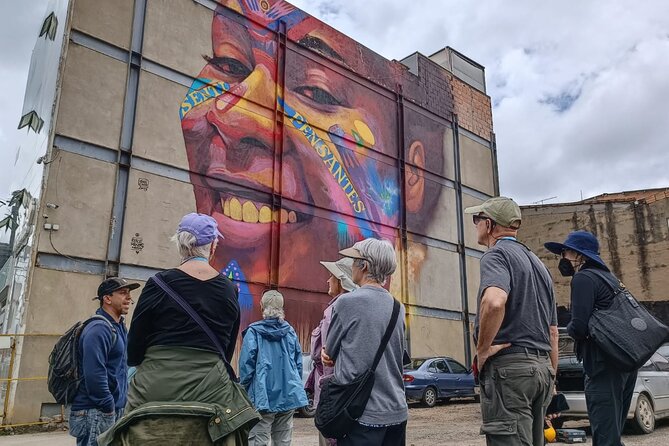
- Real street art with political context, not just photo ops
- Small group size (max 15), so your guide can slow down for questions
- Stop-by-stop variety, from wild-style graffiti to hyper-realistic portraits
- Thoughtful themes like death, ecology, spirituality, and labor
- International artists and techniques, including work by Jaune, Guache, and Sabotaje al Montaje
- Free admission at the stops, so you are not paying extra to look closely
Distrito Graffiti’s Mission: Art as a Loud, Public Conversation
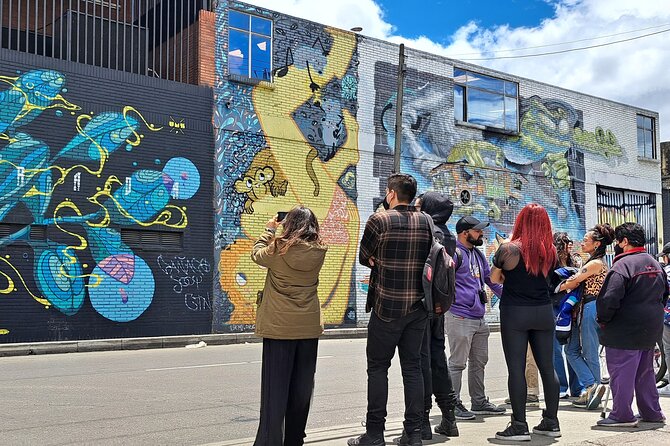
Distrito Graffiti is built around a simple idea: giant walls are for voices, not for permission slips. You’re introduced to the project’s goal of showcasing diverse international voices through impressive techniques, all in the public eye.
What makes this tour feel different is the way the murals are treated like messages with backgrounds. You do not just glance at paint. You get the angle, the reference, and the human point of view behind it.
More Comuna 13 graffiti walks:
- Graffiti Tour: a fascinating walk through a street art City
★ 5.0 · 1,074 reviews - Graffiti Tour in La Candelaria Bogotá
★ 5.0 · 315 reviews - Bogotá: La Candelaria Graffiti & Urban Art Guided Tour
★ 4.7 · 250 reviews
Meeting in Puente Aranda and Finishing Where You Started
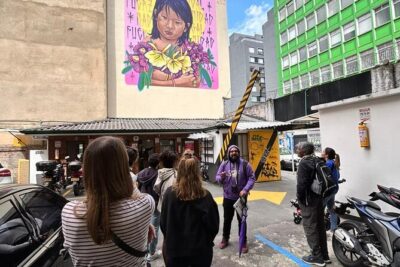
You meet at Av. de las Américas #50-85, Puente Aranda, Bogotá, and the walk ends back at the same meeting point. The route is designed as a loop, with short stops so you keep moving while still taking in details.
It runs about 1 hour 30 minutes, and with a maximum of 15 people, it stays manageable. It is also near public transportation, which helps if you are pairing this with other Bogotá neighborhoods.
Stop 1: Distrito Grafiti, Where the Project Explains Itself
The first stop is all about orientation. You get introduced to the Distrito Graffiti project and why these walls exist: to show international techniques and broaden who gets to speak through street art.
This is the moment where your guide helps you switch from viewer mode to reader mode. You start looking for symbols and references, not just style.
Stop 2: Soplascol sas and the Hoodie Artist With Real Tools
At Soplascol sas, you see a mural portraying a graffiti artist wearing a hoodie and cap, carrying spray cans and rollers. It is a straightforward image, but it works as a “starter kit” for the tour.
You see the artist as a worker, not a villain. That framing sets you up for the deeper stops where graffiti becomes protest, memory, and identity.
More things to do in Bogota:
- Bogotá Bike Tour
★ 5.0 · 3,329 reviews - Bogota: Bicycle City Tour
★ 4.9 · 2,156 reviews - Zipaquirá: Salt Cathedral Group Tour with Pickup
★ 4.8 · 1,606 reviews - La Candelaria, Monserrate and Museums Bogotá Private City Tour
★ 5.0 · 1,567 reviews
Stop 3: Eds Terpel San Andres and the Skull That Explains Coca
Eds Terpel San Andres brings a serious tone. A coca plant emerges from a skull, pushing you to think about the sacredness of death and how the plant carries meaning distinct from cocaine.
This is one of those murals that stops the walk for a minute. It is not asking you to have one opinion. It is pushing you to notice nuance, especially in how people talk about coca in Colombia.
Stop 4: TEXTILES FACTORY TEXTRAMA and Wild-Style as Abstract Writing
Next up is TEXTILES FACTORY TEXTRAMA, where wild-style graffiti is presented like abstract art. You also get a look at how graffiti is often treated as vandal art, and how the district supports it as something else.
Wild-style can feel like a locked door if you only see it from far away. Up close, though, it reads like an entire visual language made of rhythm, tension, and typography.
Stop 5: Kr 54 – Cl 5C and Jaune’s Mini Stencils of Workers
At Kr 54 – Cl 5C, you meet realistic-style mini stencils depicting everyday workers like builders and cleaners. These are connected to the Belgian artist Jaune, and the theme is clear: people who keep cities running often stay off the spotlight.
If you like street art that respects ordinary life, this stop hits. It shifts the focus away from celebrity culture and toward labor, routine, and the dignity of work.
Stop 6: Metalfischer, the Water Uterus, and Colombia’s Frailejón
Metalfischer is unusual in the best way. You see a uterus made of water, tied to the frailejon plant found in Colombia’s highland wet ecosystems.
The meaning goes beyond nature as scenery. A local female artist connects the symbol of growing equity with environmental awareness, so the mural reads like both botany and social reflection.
Stop 7: Centro Creativo Textura, Tucans, Indigenous Life, and a Jaguar Arm
Centro Creativo Textura is where color and storytelling expand. You’ll see cartoon tucans alongside indigenous communities, celebrating Colombia’s cultural heritage.
Then you get the realistic portrait moment: a woman with a small jaguar walking on her arm. The symbolism centers on harmony between humans and nature, and it feels personal rather than lecture-like.
Stop 8: LA AREPERIA DC and the Black-and-White Mental House on Fire
LA AREPERIA DC uses a stark black-and-white acrylic style. A character witnesses their mental house burning, a metaphor for beliefs being transformed and resilience.
This mural is calmer than the political ones, but it is not light. It invites a reflective pause, and it can land especially well if you’ve had a rough day traveling. Art here acts like a mirror.
Stop 9: Industrias Proton Ltda and Salsa’s Spiritual Blend
At Industrias Proton Ltda, a man plays the trombone with a rosary coiled around the instrument. The mural connects spirituality and music, with a specific nod to salsa.
It is a great example of how Latin American street art can be both playful and grounded. You see faith and rhythm in the same frame, not treated as opposites.
Stop 10: TelefonoPostobón Planta San Rafael Industrial, Guache’s Afro Portrait Plus Ecology and Nostalgia
This is one of the most packed stops. You admire a giant portrait by renowned Colombian artist Guache, featuring an Afro-Colombian woman in his signature style. The artwork represents sentipensar, blending contemporary views with ancestral indigenous philosophy.
Then you shift to environmental awareness: a mural showing a plastic bag floating in the ocean, a direct signal about pollution and waste. Finally, you end the stop with an artwork featuring an old telephone, triggering nostalgia and a reflection on how fast communication changes.
Stop 11: COMTUCAR S.A.S and Sabotaje al Montaje’s Four-Story Old Man
COMTUCAR S.A.S takes scale to the next level. You face a four-story-tall hyper-realistic portrait of an old man by the Spanish artist Sabotaje al Montaje.
Hyper-real portraits in public spaces work because they force eye contact. Instead of walking past a wall, you react to a human presence, and you carry that emotion into the next stops.
Stop 12: FIORENZI CEDI, Train Graffiti Coexisting With Muralism, Plus a Psychedelic Totem
At FIORENZI CEDI, you see graffiti on trains and the way muralism styles coexist on buildings. The theme is about how different street art scenes overlap, influence each other, and compete for space in the city.
You also spot a giant totem adorned with a Colombian indigenous symbol, created by a Brazilian crew. It is psychedelic in color and celebrates indigenous cultures, adding another layer of regional conversation beyond Colombia alone.
Stop 13: Todo Cajas Jemd S.a.s, Sci-Fi Wonder and a School-Book Clock
Todo Cajas Jemd S.a.s turns imaginative. One mural shows a sci-fi alien creature grasping planets, pulling you into the mysteries of the universe.
The other mural is poetic and education-focused: a child with a school bag shaped like a book, with a clock marking the beginning of class. The child gazes at a magnificent bird, and the symbolism ties knowledge to imagination.
Stop 14: Inversiones Merlup Sas and the Tour’s Human Closing Moment
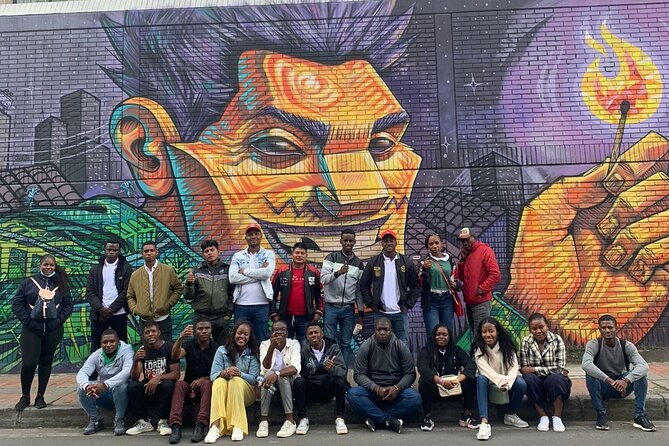
The last stop is practical and emotional. You get a group picture and some final insights about how art can transform how you see Bogotá and how you see yourself.
This closing moment matters because you finish with meaning, not just a list of murals. You walk away with a lens you can use the next time you pass street art in another neighborhood.
Guides Are the Secret Sauce: Jay, Jeff, Camilo, Jahir, and Tet.artist
The tour’s standout strength is the guide’s ability to connect visuals to context without turning it into a dry lecture. Guides like Jay and Jeff are known for strong explanations and answering questions, while Camilo and Jahir add their own storytelling rhythm.
If you are new to street art, this helps a lot. You do not need to already know graffiti culture to follow the symbolism. The guide works like a translator between paint and meaning.
Price and Value: $25 for a Lot of Wall Time
At $25 per person for about 1.5 hours, this is a high value way to see a concentration of major murals without paying more per site. The route includes a guided explanation at multiple stops, and each location is treated as a chapter rather than a quick glance.
It also saves you effort. Walking the area on your own might be fun, but you would likely miss the key connections, like the coca versus cocaine distinction, the frailejón plant reference, or the logic behind the workers stencil theme.
If you are budgeting, this is one of the easier categories to justify: you pay once, then spend your time absorbing art, stories, and political context in an organized loop.
Who Should Book Walls of Wonder, and Who Might Skip It
Book this if you want street art with layers: politics, identity, ecology, labor, and spirituality. It also suits you if you enjoy guided interpretation, because the stops are short enough to keep your attention but still deep enough to matter.
Skip it if you want a slow, sit-down museum style. This is outdoors and walk-based. Also, it is not recommended for limited mobility, so if that is a concern, pick another activity that matches your pace.
Should You Book Walls of Wonder?
Yes, if you want your Bogotá street art to come with explanations and themes you can remember. The small group size, the focus on big murals, and the mix of international and local artists make it a strong use of 90 minutes.
If you are sensitive to deep topics like death symbolism or you prefer purely decorative art, you might still enjoy it, but go in knowing some stops are heavy. Bring comfortable shoes and a curious mindset, and you’ll get a lot more from these walls than you expect.
FAQ
How much does the Walls of Wonder tour cost?
The price is $25.00 per person.
How long is the tour?
The duration is approximately 1 hour 30 minutes.
Where does the tour start and end?
You start at Av. de las Américas #50-85, Puente Aranda, Bogotá, Colombia, and the tour ends back at the same meeting point.
How many people are in a group?
The tour has a maximum of 15 travelers.
Is this tour guided?
Yes. It includes a guided tour.
Is food included?
No. Food and tips are not included.
Are admission tickets required for the stops?
Admission tickets are free at the listed stops.
Is the tour suitable for limited mobility?
It is not recommended for travelers with limited mobility.
Are service animals allowed?
Yes, service animals are allowed.
Hot off the list in Bogota
- Tour of Zipaquirá: Visit the Salt Cathedral and the main squares★ 4.5 · 55 reviews
- Zipaquirá and Salt Cathedral Muisca Heritage with Guide – Private★ 4.5 · 23 reviews
- Catedral de Sal desde Bogotá en Tren★ 5.0 · 5 reviews
- Zipaquira Salt Cathedral★ 5.0 · 4 reviews
- LOCAL GUIDE Zipaquirá PRIVATE TOUR – Salt Cathedral and Salt Oven★ 5.0 · 24 reviews
- Zipaquirá Salt Cathedral: An architectural wonder.★ 4.5 · 24 reviews
- Private Zipaquira Salt Cathedral and Guatavita Lagoon Tour from Bogota★ 4.5 · 44 reviews
- Zipaquira Salt Cathedral★ 4.5 · 12 reviews
Comuna 13 Tours, compared.
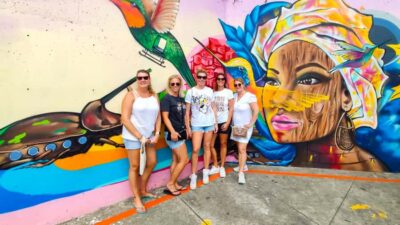
Comuna 13 Graffiti Tour, Cable Car & Street Food
Read our review →
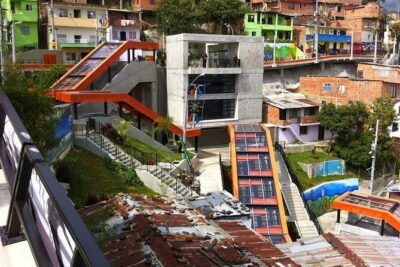
Comuna 13 Graffitour knows the urban art district of Medellín
Read our review →
City tour Medellin + Comuna 13 + Graffititour Paisa for a day
Read our review →
Guided Tour of Comuna 13 Medellín with Snacks Included
Read our review →
Graffiti Tour: a fascinating walk through a street art City
Read our review →Browse the lists this tour appears in